SonicNEST at
Berklee College of Music
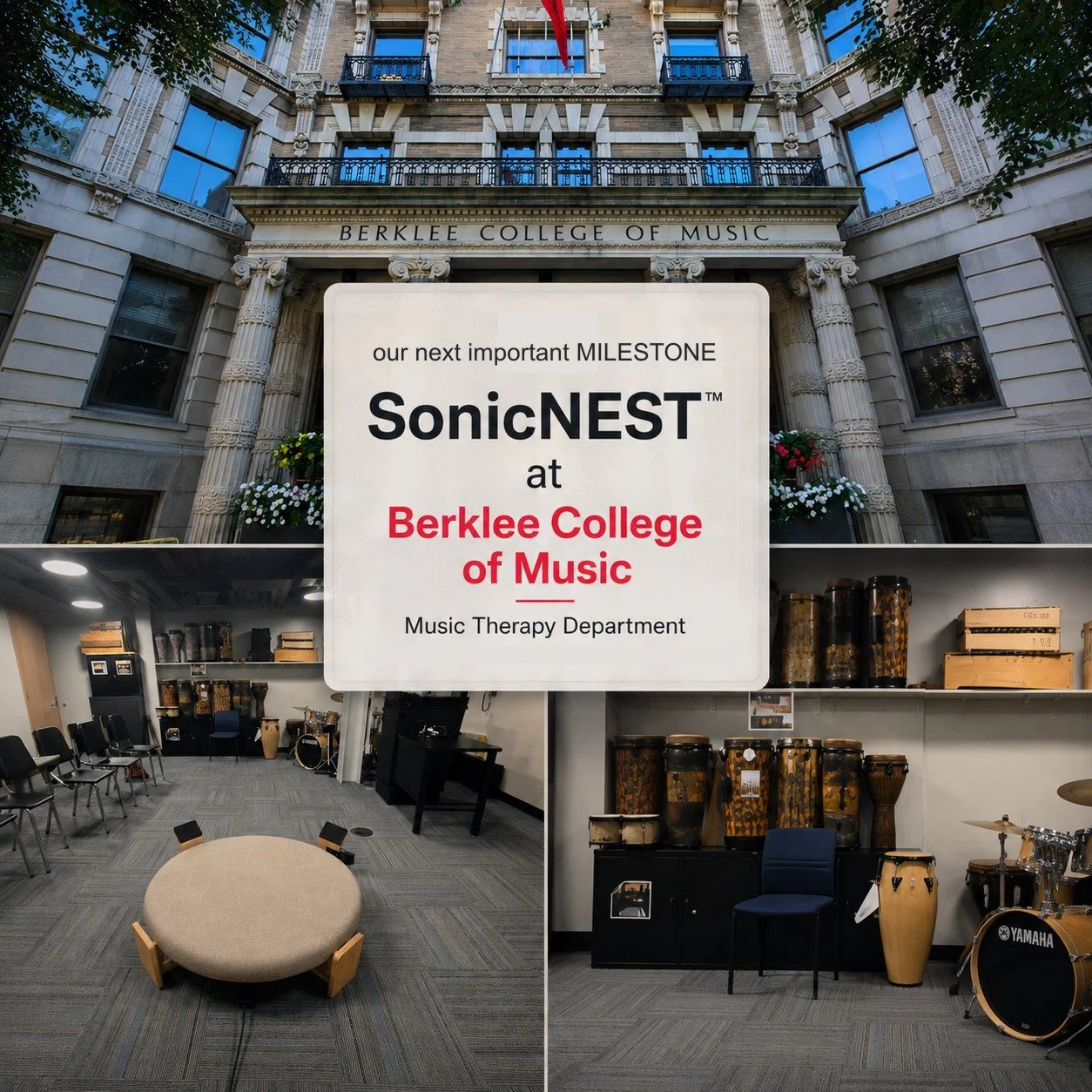
Professional Listening Session
Boston · August 26, 2026
A Very Special Place for Music
For those who may not be familiar with Berklee College of Music, it is one of the world’s leading institutions dedicated to contemporary music and the performing arts.
Many internationally recognized artists, composers, producers and innovators have studied at Berklee or are counted among its alumni. They include Quincy Jones, Diana Krall, Howard Shore—composer of the music for The Lord of the Rings and The Hobbit—John Mayer, Steve Vai and Esperanza Spalding.
Across generations and musical genres, Berklee has helped shape the careers of artists whose work has influenced contemporary music around the world. Collectively, Berklee alumni have received more than 300 Grammy Awards.
For SonicNEST, being invited into this environment was both an honor and an important moment in the project’s journey…
Where Music, Human Experience and Well-Being Meet
What made this visit particularly meaningful was not only the institution itself, but also the professional environment in which the presentation took place.
The session was connected with Berklee’s Music Therapy Department and its wider Music and Health ecosystem.
Berklee describes its undergraduate music therapy program as one of the largest and most respected programs of its kind in the world. The Music and Health Institute serves as a hub for cross-sector collaboration, applied research and real-world program development—bringing together music, healthcare, education, technology and human-centered innovation.
This made it a particularly relevant setting for presenting SonicNEST.
SonicNEST was created to explore a deeper relationship between music, spatial sound, body-felt vibration, focused attention and emotional experience. It is currently positioned as a non-medical platform for immersive listening, relaxation and well-being.
The Berklee session offered an opportunity to observe how this concept would be received by people working professionally at the intersection of music and human experience.
The Purpose of the Session
The purpose of the meeting was not to deliver a conventional sales presentation.
It was to give members of Berklee’s faculty and staff the opportunity to experience SonicNEST directly, explore the concept in practice and share their honest professional observations.
Rather than attempting to explain the complete experience through technical language, the session placed direct experience first.
Each participant was invited to enter the SonicNEST listening space individually, listen to selected musical material and notice the relationship between sound, vibration, physical presence, attention and imagination.
There were no suggested reactions and no expected conclusions.
The central question was simple:
What happens when music is not only heard—but also physically experienced?
Inside the SonicNEST Experience
During the session, three members of Berklee’s faculty and staff experienced the SonicNEST prototype individually.
Each listening experience lasted approximately eight to ten minutes and included carefully selected musical excerpts representing different rhythms, textures and emotional atmospheres.
The listener was positioned at the center of a near-field high-fidelity stereo system integrated directly into the physical structure of SonicNEST.
No headphones were used.
There were no additional rear speakers and no DSP-generated surround effects. The immersive spatial impression was created through the physical geometry of the system, close-range stereo reproduction and the listener’s position within the sound field.
At the same time, synchronized low-frequency vibration was transmitted through the seat and physically experienced by the body.
The purpose was not simply to increase the amount of bass. It was to create a coherent relationship between what the listener heard and what the body felt.
Immediate Professional Observations
Despite the short duration of each session, the reactions were immediate and detailed.
Participants described a strong three-dimensional quality of sound and a feeling of being placed inside the musical scene rather than listening to it from the outside.
The experience was associated with:
a sense of music surrounding the listener;
vivid mental imagery and changing internal scenes;
the impression of musicians performing nearby;
sound appearing to extend behind and around the body;
physical integration of rhythm through vibration;
rapid absorption into the experience;
relaxation despite energetic and rhythmically complex music;
and a reduced awareness of the surrounding room.
The session demonstrated that even a brief SonicNEST experience could create a strong sense of spatial and physical immersion.
“The Sound Is Impeccable”
Personal Experience Shared by Rob Moore
Department Coordinator, Music Therapy · Berklee College of Music
“The sound is impeccable. I truly felt like I was in the middle of every scene the music brought to my mind.
It really felt like a live band was all around me—and at times, as if the band was having a concert inside my body.
Even the incredibly fast drumming felt almost like sitting in a massage chair. It was very relaxing.
The sound placed me right in the middle of every scene the music brought to my mind: from a caravan in the Saharan desert, to a jazz club in New York City, to a big, booming nightclub in Berlin.”
Rob’s description captured one of the central qualities repeatedly associated with SonicNEST: the experience does not remain limited to the loudspeakers.
Music can be perceived as a surrounding environment—one that creates spatial scenes, physical sensations and an unusually direct emotional connection with the listener.
More Than Sound Alone
The physical design and construction of the prototype also became part of the professional observation.
Rob Moore noted:
“I also loved the way everything was wired within the device. The entire unit looked clean, thoughtfully designed, and extremely well made, without unnecessary parts or excess elements.”
This observation is particularly meaningful because SonicNEST was developed independently and built by hand.
Its physical form is not simply a frame supporting audio components. The dimensions, position of the loudspeakers, geometry around the listener, seating structure and distribution of vibration all contribute to the final experience.
The aim is to create a coherent personal space in which sound, body and attention can meet without unnecessary technological complexity.
Honest Feedback as Part of Development
The Berklee session was not treated as a search for automatic approval.
Professional feedback is valuable precisely because it can reveal both the strengths of the current prototype and the areas that may require further development.
The discussion included observations concerning:
the integration of sound and body-felt vibration;
the speed at which the listener entered the immersive experience;
the relationship between energetic music and physical relaxation;
physical comfort during longer sessions;
transitions between musical excerpts;
and the potential value of longer, more structured observation.
These insights became part of the continuing development process.
SonicNEST remains an evolving platform. Each carefully documented professional experience helps refine not only the construction of the system, but also the way sessions are prepared, presented and understood.
Why This Moment Matters
SonicNEST began as an independently developed idea: a personal space where music could be experienced in a more spatial, physical and emotionally engaging way.
It was then transformed into a working prototype through years of audio experience, direct experimentation, handcrafted construction and critical listening.
Bringing that prototype from Poland to Boston and presenting it within Berklee’s professional Music Therapy environment represented an important step.
The session did not constitute a clinical study or formal scientific validation. Its value came from something more fundamental at this stage: direct professional experience, honest observation and meaningful feedback from people whose work is closely connected with music and its relationship with human experience.
For SonicNEST, this was a significant milestone—and an important confirmation that the experience can communicate its character within only a few minutes.
Open to Further Professional Exploration
SonicNEST remains open to different forms of responsible professional and academic collaboration.
Possible future directions may include:
longer professional listening sessions;
structured non-clinical evaluation;
observation with a small group of participants;
exploration within music, well-being and immersive listening;
or making a SonicNEST unit available for an agreed evaluation period.
Any future activity would require a clearly defined purpose, appropriate conditions and mutual agreement between the parties involved.
The objective would not be to seek a predetermined positive conclusion, but to understand the experience more deeply—its potential value, its limitations and the directions in which it could responsibly develop.
With Gratitude
This presentation would not have been possible without the openness, trust and time of the people who helped organize and participate in the session.
I am sincerely grateful for the opportunity to bring SonicNEST to Berklee College of Music and to allow the system to be experienced within such a respected professional and academic environment.
For an independently developed, hand-built innovation from Poland, this was a meaningful moment—and one that will remain an important part of the SonicNEST journey.
Tom Fechter
Founder & Creator of SonicNEST™
This page documents an independent presentation and the personal observations of participants. The session was not a clinical study and does not represent an official partnership, institutional evaluation or endorsement by Berklee College of Music.